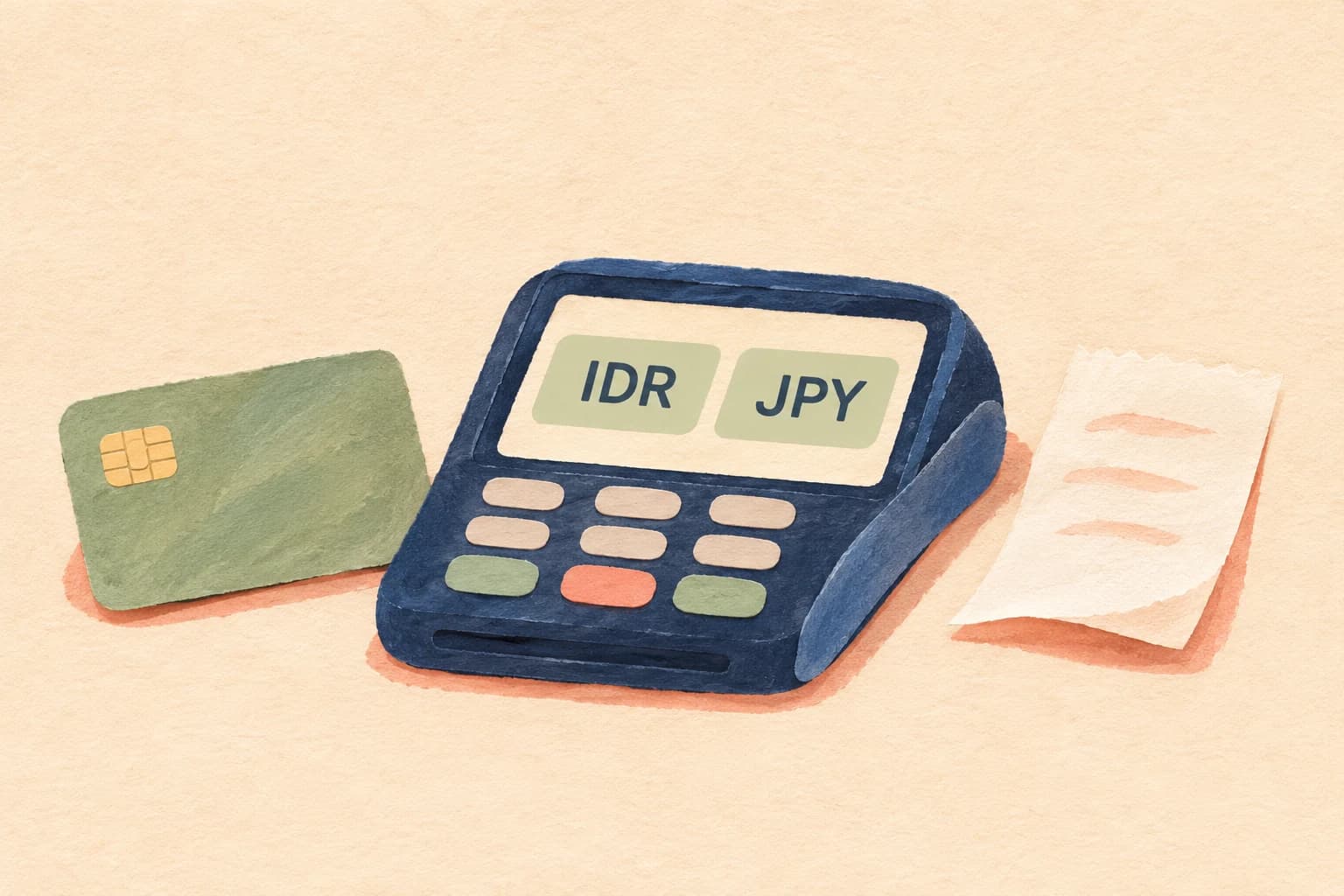
If a card terminal in Bali offers IDR and your home currency, you may be choosing whether to accept Dynamic Currency Conversion (DCC). Choose a transaction in the local currency, IDR, if you do not want the merchant's currency conversion. That does not mean the payment is fee-free or guaranteed to be the cheapest option: check the displayed conversion terms separately from your card issuer's terms.
DCC changes the transaction currency, not the display language
DCC lets a merchant or ATM convert a foreign transaction into the cardholder's home currency. Recognising the amount in a familiar currency is a convenience, not evidence of a favourable rate. Choosing an English-language screen is not the same decision as choosing a transaction in your home currency.
Visa's official DCC guidance says merchants and ATMs must clearly display the amounts in local and cardholder currencies, both currency symbols, the conversion exchange rate and additional fees or markup on the screen and receipts. This is Visa's guidance, not a statement of the fees for your particular card.
Read four things before confirming
- Does the IDR amount on the terminal match the merchant's bill?
- What is the other currency being offered? For a Japanese-yen option, look for JPY.
- Can you identify the DCC exchange rate and additional fees or markup?
- Can you make your own choice to accept or decline the conversion?
Read the currency names and explanations rather than choosing by button colour or size. If you want to decline the merchant's conversion, you can say, “Please charge me in IDR, without currency conversion,” and check the display before confirming. This is a suggested phrase, not a claim that every terminal has identical wording or controls.
Choosing IDR does not remove your card's own conditions
Declining DCC is different from eliminating the costs of using your card overseas. Before travel, read your issuer's official information about conversion methods and fees, including its treatment of foreign-currency and home-currency transactions abroad. A familiar home-currency amount is not automatically better value.
This guide does not quote a current exchange rate or promise a saving. For exchanging physical cash, see the money-changing guide. For taxes and service charges on a merchant's bill, see the price-label guide.
At an ATM, separate the cash currency from conversion
An ATM can offer to bill you in your home currency even when it dispenses rupiah. Receiving rupiah notes therefore does not tell you whether you declined DCC. Read the separate currency-conversion choice on the screen.
Check ATM charges and your card's cash-withdrawal conditions separately too. Do not treat “decline conversion” as a button that removes every fee. If you cannot understand what you are approving, stop rather than confirm, and check with your card issuer if necessary.
If the receipt does not match your choice
Check the amount and currency on the receipt and retain a copy. If they differ from what you chose, raise it with the merchant; contact your card issuer if it remains unresolved. This is not a guarantee that a correction or refund will be available.
Visa recommends declining DCC and reporting the incident to the issuer if the required information is missing or you feel pressured to choose a particular currency. Its guidance also says merchants and ATMs must not make the choice on your behalf.
These are general checks for purchases and ATM use during a trip, not a claim that Villa Rumah Wayan has a card terminal or offers DCC. Check the official FAQ and staff instructions for accommodation payment methods. Bookings are request-based and are confirmed after availability and payment have been checked.
Visa's DCC guidance and the official FAQ were checked on 10 November 2026. The accompanying image is an AI-generated illustration of a currency choice, not a photograph of a real terminal, property or payment screen.